
Four capitals and a funeral
By José Piñera, minister of Mining, 1980-1981
[Note: No sooner had the Mining Law bill been tabled before the legislative commissions on 17 August 1981 than I received an extraordinary invitation from Margaret Thatcher’s government to visit Britain and elaborate on the “seven modernisations”. What was planned as a single-country mission rapidly evolved into a whirlwind tour of four capitals – Paris, Rome, Cairo and London – culminating in attendance at the sombre state funeral of President Anwar Sadat. A short recollection.]
Paris, 5 October
I land before dawn in what remains the most beautiful capital on earth for the annual gathering of mining ministers from the CIPEC copper-exporting nations. The proceedings are routine – more diplomatic choreography than serious policy discussion.
Paris, 6 October
The conference scarcely concluded, Chile’s ambassador to France, Juan José Fernández, invites me to the embassy residence in the Rue de la Motte-Picquet, hard by Napoleon’s tomb at Les Invalides, for an informal birthday celebration: fine conversation and even finer French champagne. On arrival we are confronted by television footage of the horrific assassination, only hours earlier, of Egypt’s President Anwar Sadat during a military parade in Cairo. Sadat’s death threatens to unravel the fragile stabilising architecture the United States had painstakingly erected in the Middle East after Camp David. The region, always tragic in my view, appears once more on the precipice of war and escalating violence.
From Paris to Rome, 7 October
Early the following morning Ambassador Fernández telephones with urgent news: a telex from Santiago instructs us that the President of the Republic has named me head of the Chilean delegation to Sadat’s funeral.
I depart for Rome as scheduled at 5 p.m., but now know that the itinerary must extend to Cairo the next afternoon in company with Ambassador Fernández.
Rome, 8 October
The ambassador to the Holy See, Héctor Riesle, had arranged a packed schedule of audiences with senior Vatican prelates and ecclesiastical intellectuals: Archbishop Eduardo Martínez Somalo, Substitute Secretary of State; Archbishop Lucas Moreira Neves; the Jesuit Bartolomeo Sorge, editor of La Civiltà Cattolica; and Archbishop Achille Silvestrini, Secretary for Public Affairs. To each I outline Chile’s far-reaching reforms – a project of profound consequence for the developing world, grounded in liberty and equality of opportunity.
In a free hour I pay a quiet visit to my cousin María Teresa Chadwick Piñera, living in exile in Rome with her husband José Antonio Viera-Gallo, Allende’s former deputy justice minister. An embassy official warns that Santiago will frown on the gesture; I pay no heed.
That evening I board an aircraft packed with dignitaries bound for Cairo. The Prime Minister of Thailand sits beside me. We land late at night in a city under iron curfew – a spectral capital. Formalities are glacial; almost every passenger belongs to a funeral delegation, and the Egyptian foreign minister greets us individually. Tension hangs thick in the air. At the airport the official jets of several powers stand on distant aprons, floodlit and ringed shoulder-to-shoulder by troops. Once clear of the terminal, movement is sudden and swift: motorcades race delegations to hotels reserved for foreign dignitaries.
Cairo, 9 October
At first light Ambassador Fernández, the Egyptian ambassador Rolando Garay and I drive to the very sun-blasted parade ground where Sadat fell. There, beneath vast canvas awnings, the delegations shelter from the heat while awaiting the gun-carriage bearing the president’s remains. The assembly of world figures is staggering. To my left stands President Valéry Giscard d’Estaing of France; nearby, the Prince of Wales with Lord Carrington; a little further off, King Baudouin of the Belgians. Behind them, the Israeli Prime Minister Menachem Begin, surrounded by most of his cabinet. Not far away, the formidable American party led by Secretary of State Alexander Haig and including three former presidents – Nixon, Ford and Carter – together with Henry Kissinger. The Arab monarchies provide an even more colourful spectacle of kings, princes and sultans. Conversation is hushed but incessant; silence is nowhere to be found. Suspicion is almost tangible, and impatience grows by the minute.
After half an hour the muffled drums announce the approach of the caisson. The family follows, then the Egyptian government. Once the coffin reaches the canopy, we form a vast procession across the parade ground – perhaps a kilometre – each dignitary encased in a moving wall of security men. Egyptian troops line the route, faces grim; overhead, military helicopters roar. A brief religious rite, a military salute, and the remains are interred. Abruptly the loudspeakers direct heads of delegation to an adjacent building to offer condolences to the widow and to President Mubarak. Chaos ensues: security details collide, formations disintegrate.
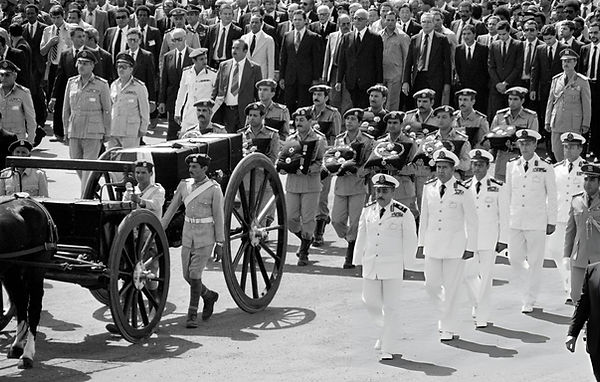
Ahead of me walks the American party. A small drama unfolds. The Egyptian general at the door refuses entry to the three former presidents – they lack the correct badge and are not formal heads of delegation. Haig protests with exquisite courtesy that if Nixon, Ford and Carter are excluded, he too will remain outside. Though I, as accredited head of delegation, could pass immediately, I choose solidarity and strike up conversation with the ex-presidents. Five long minutes elapse until the deputy foreign minister – Boutros Boutros-Ghali, the future UN Secretary-General – arrives to authorise the exception. I reflect that men who once wielded greater power than almost any in history are, by a general from an army they themselves equipped, momentarily reduced to the ranks of ordinary citizens. No setting could be more apt than Egypt for contemplating the transience of power – a land that is itself the tomb of a mighty ancient empire and the sepulchre of countless dynasties that once defied eternity.
The condolences themselves are hurried. Everyone wishes to leave Cairo at once; lingering feels like handling dynamite. With so many leaders concentrated in one place, any misstep could ignite a holy war. The extent of military complicity in the assassination remains unknown. After conveying Chile’s sympathies to Jehan Sadat and President Mubarak, the delegations sprint to waiting cars and are whisked to the airport, deposited at the foot of their aircraft steps. My own British Airways flight to London departs hours later, allowing a leisurely lunch beneath the pyramids that once looked down on Napoleon’s victorious legions.
London, 11–15 October
I arrive on an official visit to Thatcherite Britain. The warmth of the welcome is striking; I am repeatedly reminded that I am the first minister from Chile’s military government to be invited to London – a mark of keen interest in our reforms, above all the labour-law overhaul and the creation of individual capitalisation accounts.
Thatcher’s chief economic adviser, Alan Walters – whom I already know from his visits to Santiago – and Cecil Parkinson, a rising star in her circle, are among my hosts. At a luncheon given by Evelyn de Rothschild with the chairmen of Britain’s leading mining houses, I outline the constitutional mining law then before parliament. Knowing that Rothschild chairs The Economist, I mention my long-standing admiration for the paper. Within minutes he arranges a meeting with its editor, Andrew Knight, and accompanies me there. We talk for hours about Chile’s free-market revolution – an experiment that, in several respects, is running ahead of Thatcher’s own liberalisation programme.
The next day I ask Ambassador Miguel Alex Schweitzer – who has done stellar work – to drive me to Blenheim Palace to pay homage to Winston Churchill, born in the ancestral seat of the Dukes of Marlborough. The historian Hugh Thomas invites me for tea in the House of Lords. I also address Britain’s two premier think-tanks, the Institute of Economic Affairs and the Adam Smith Institute.
My final engagement is the keynote speech at the annual dinner of the London Metal Exchange, held at the Dorchester and attended by some two thousand miners, investors and traders. For the first – and thus far only – time on the tour I encounter a picket line. A handful of protesters at the hotel entrance brandish placards reading “Piñera Go Home!” To the consternation of my British escort, I walk over, smile, and inform them (to laughter) that by this stage of the journey going home is precisely my dearest wish, and that once the speech is delivered I shall indeed pack for Santiago – so they may lower their signs with confidence that permanent residence in perpetually overcast London is not part of my plans.
A few days later I am back in Santiago, ready for the final push to secure passage of the Constitutional Mining Law – the fruit of a year’s intensive labour and the key to the future of Chile’s most vital economic sector

Private Mining: The engine of Chile's growth (October 2025)